Community
 Print
Print




There’s something timeless about a stack of crepes fresh from the pan. In a recent video, Lionel Roudaut, known for his YouTube channel My Vegan Provence, shows how to recreate that experience with vegan orange zest crepes that taste just like the ones he grew up with. The recipe keeps the heart of the dish intact while removing eggs and dairy entirely.
Roudaut is a passionate French cook and world traveler who focuses on reinventing traditional French recipes using plant-based ingredients. Much of his inspiration comes from Provence, where food is deeply tied to memory and place. Here, he draws on childhood moments in his family kitchen, explaining: “For me, [the Christian holiday of] Candlemas means memories of my mom’s crepes made in our kitchen in the South of France.”
Read more: These 4 Ingredient Vegan Crepes Can Be Made Sweet Or Savory
Crepes are typically made with eggs, milk, and butter. But Roudaut replaces eggs with potato starch, creating a batter that behaves in much the same way. He also adds a key ingredient that defines the entire recipe: orange zest. As he puts it, “Today, I will show you how to make them without eggs or dairy, and a secret, orange zest, of course.”
A simple batter with a clever plant-based swap
The base of these vegan orange zest crepes starts in a mixing bowl with flour and potato starch. The starch plays a crucial role, acting as the binding agent that eggs would normally provide. Roudaut explains that this is “the magic substitute that replaces eggs without ruining the texture.”
He builds the batter with sugar, salt, olive oil, soy milk, and water, whisking until completely smooth. The consistency matters. “This is the consistency of the dough that you want to end up with. Not too thick, not too thin,” he says.
One important step happens before any cooking begins. After mixing, the batter rests in the fridge overnight. This allows the ingredients to fully hydrate and develop structure. When he returns to it the next day, the mixture has thickened and separated slightly, so he adjusts it carefully. “I find that the batter is a bit too thick, so I’m adding a bit of water… a little bit of water at a time.”
Orange zest makes all the difference
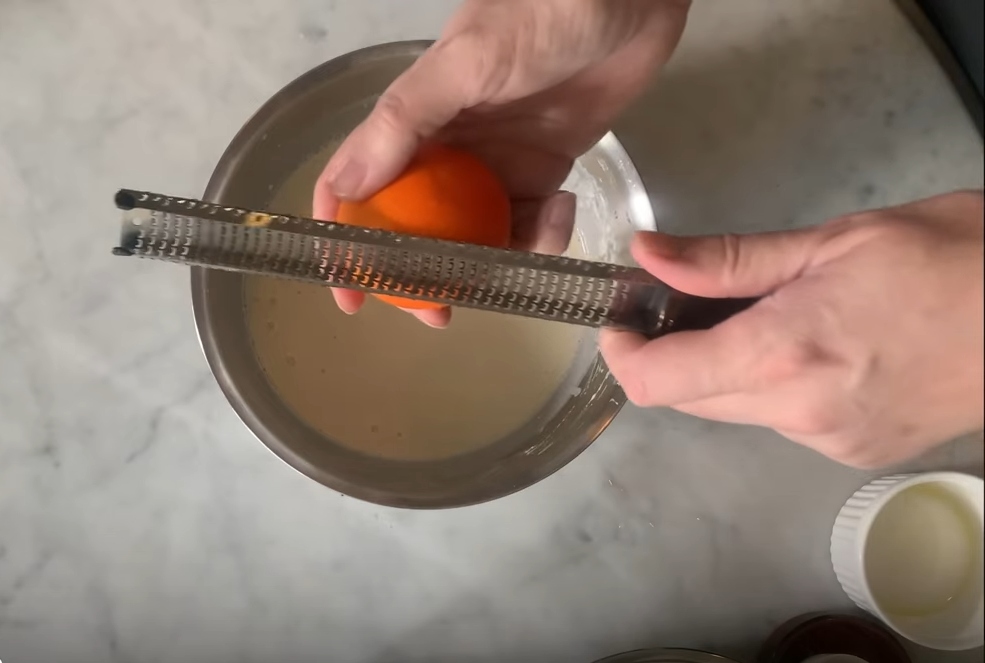
The defining feature of these vegan orange zest crepes is, unsurprisingly, the citrus. Roudaut uses fresh oranges and carefully removes the zest, avoiding the bitter white pith. He then mixes it directly into the batter before resting it overnight.
This step is not just about flavor. It is about recreating a memory. The aroma and subtle sweetness of the orange bring the crepes closer to the version he remembers from childhood.
Later, he emphasizes just how important this step is: “Really get your hands on organic oranges and really add that zest overnight into the dough. It’s miraculous.”
Before cooking, he strains the batter to remove the zest pieces, leaving behind a smooth mixture that still carries all the infused flavor.
Technique, patience, and practice
Cooking crepes is as much about technique as it is about ingredients. Roudaut keeps the heat at medium and takes time to properly grease the pan, explaining that a thin, even layer of oil is key to preventing sticking.
Once the batter hits the pan, he rotates it to create a thin, even layer. Timing is precise. “Let the crepe cook for one minute, thirty to two minutes on that side,” he says, watching for the edges to lift.
Flipping is where confidence comes in. “You need to be very quick and your movement needs to be very decisive,” he explains, while also offering a more cautious alternative: using a spatula if needed.
He notes that skill improves quickly with repetition. “Making crepes is not difficult, but it requires practice and confidence.”
As each crepe finishes, he stacks them under a towel to keep them warm and soft.
A nostalgic taste that feels familiar
When it comes time to eat, Roudaut keeps things simple. He sprinkles his crepe with sugar and folds it into quarters, letting the flavor speak for itself.
The result is exactly what he set out to achieve. “The first thing that you taste is orange zest. It’s really really nice,” he says. He also highlights the texture: “It’s a very soft crepe… It’s not dry.”
Despite being fully plant-based, the crepes stay true to the original. “If you try this, you will never know it’s a vegan crepe. It’s exactly like the original one and maybe better.”
These vegan orange zest crepes show how small changes can transform a traditional recipe without losing what makes it special. By swapping eggs for potato starch and infusing the batter with citrus, Roudaut recreates a dish rooted in memory while making it accessible to a wider audience.
For more creative plant-based twists on classic French and Provençal dishes, visit My Vegan Provence YouTube channel.
Read more: Banana Tarte Tatin French Toast