Community
 Print
Print



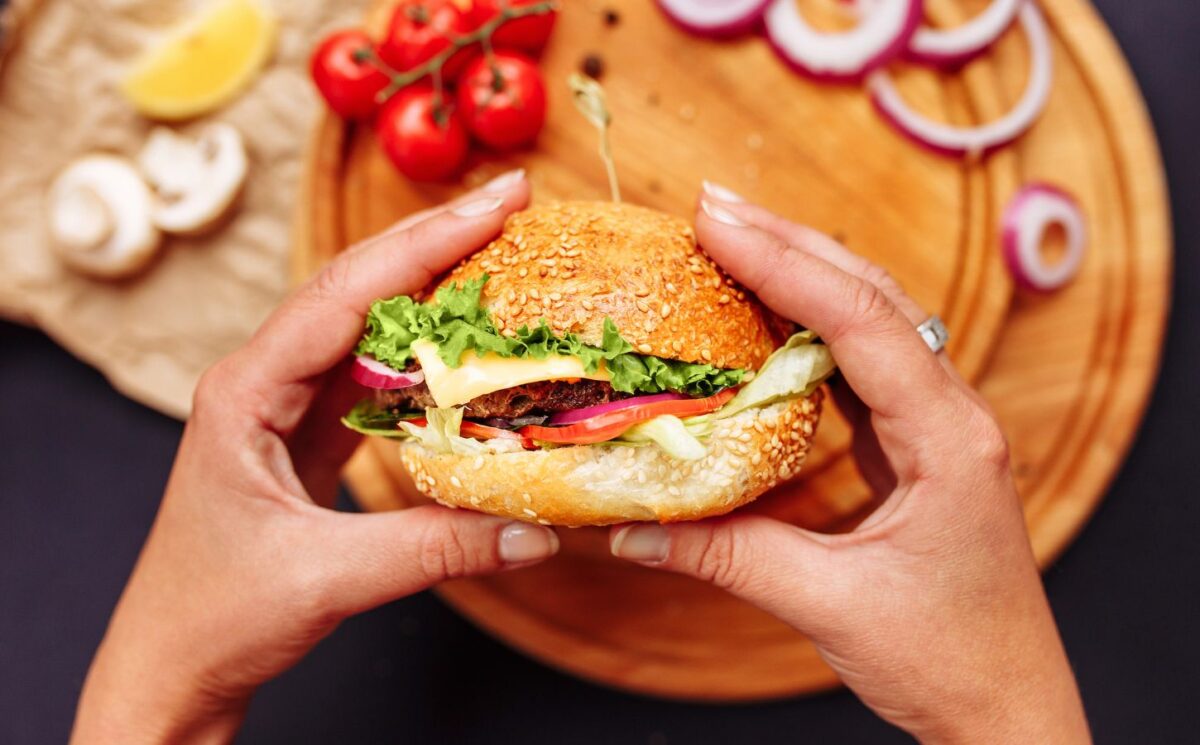
A new study has found that generative AI can help create more delicious, sustainable, and nutritious burgers, including plant-based options.
“BurgerAI” could also be used to design a customized burger recipe based on a person’s age, taste preferences, nutritional needs, and sustainability goals.
Read more: Industry-Backed Research More Likely To Say Meat Is Beneficial, Finds Study
Researchers at the University of Stanford developed the BurgerAI tool to create new and improved burger recipes. The generative tool learned patterns from 2,216 existing recipes to design new ones that optimize deliciousness, nutrition, and sustainability, and to create personalized options based on gender, age, and lifestyle.
Ellen Kuhl, a professor in Stanford’s School of Engineering and the director of Stanford Bio-X, an interdisciplinary life sciences institute, led the research. She said, “Most AI systems are trained to predict what already exists. We wanted AI to invent what should exist next. […] BurgerAI does not ask, ‘What burger is most likely?’ It asks, ‘What burger best satisfies these important and complex objectives?’”
Plant-based, vegetarian, and hybrid burger patties
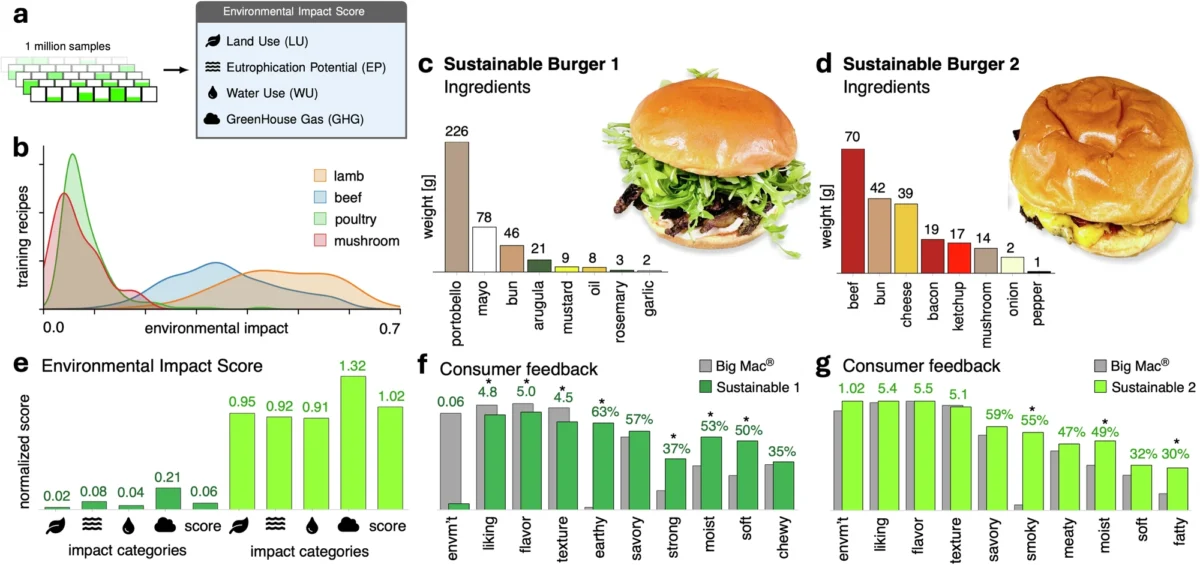
The researchers selected several recipes for taste-testing. These included a plant-based mushroom burger with an environmental impact score more than 90 percent lower than a McDonald’s Big Mac, one of the most widely consumed burgers in the world. A vegetarian burger patty, made primarily with beans but containing egg as a binder, had a Healthy Eating Index Score nearly 200 percent higher than that of a Big Mac and an environmental impact score that was approximately 83 percent lower.
Meanwhile, a recipe with both mushroom and beef still had a reduced environmental impact compared to all-meat options, and featured comparable palatability to a Big Mac, showcasing the potential of hybrid products for meat-reducers.
According to the taste-testers, the AI burger recipes developed to emphasize palatability taste the same or better than a traditional Big Mac, with a similar texture.
“AI did not just generate plausible burger recipes – it created burgers that real people enjoy,” Kuhl said. “That may sound simple, but it means the model learned what makes food appealing to the human palate and was able to navigate a design space with near-infinite possible burger combinations to find real-world solutions.”
npj Science of Food published the study at the end of June, and a second study, revealing the mathematical principles behind BurgerAI, is expected later this year.
Read more: Cultivated Meat Startup Develops Roe Deer Venison Cells
‘AI can transform food design into a quantitative science’
Earlier this year, two studies by a team of researchers at the London School of Hygiene and Tropical Medicine found that eating fewer animal products and more plant-based foods had clear benefits for human health and the environment.
However, taste and texture remain key obstacles for the widespread uptake of alternative proteins amongst meat-eaters. The new research by Kuhl’s team could potentially help producers to improve the palatability, nutrition, and sustainability of plant-based foods simultaneously, thereby increasing their benefits and uptake.
“For centuries, food design has been a matter of intuition, experience, and trial and error,” Kuhl added. “We are beginning to show that AI can transform food design into a quantitative science with applications in other important fields.”
PBN runs a sponsored content model. To explore how you can get featured, please email [email protected] or visit everkinddigital.com