Community
 Print
Print




Few things improve a warm afternoon quite like a glass of vegan Thai tea, especially when most of the work has already been done. In a video shared on his popular Yeung Man Cooking YouTube channel, Wil Yeung demonstrates how to prepare a rich, plant-based version of the iced drink in batches, leaving enough tea and homemade coconut condensed milk in the fridge to keep the drinks coming for days.
Yeung is a Hong Kong-born Canadian cookbook author, filmmaker, photographer, entrepreneur, violinist and self-taught YouTube cook. His four cookbooks draw together recipes and inspiration from his channel, which focuses entirely on plant-based food.
Read more: This Avocado Green Curry Is A Popular Thai Dish
Yeung introduces the tea, known as “cha yen” in Thailand, as one of his favorite drinks and describes it as “so decadent, it basically is a dessert.”
That dessert-like quality begins with a homemade condensed milk made from coconut cream.
The coconut condensed milk needs patience
For more irresistible plant-based recipes from around the world, check out Wil Yeung’s YouTube channel.
Yeung starts by explaining that coconut cream naturally separates into water and fat. The thick, rich portion is what gives the plant-based condensed milk its body.
He adds roughly 1 cup of coconut cream to a small saucepan, noting that canned coconut cream can also be used. Any coconut cream left over can be saved for another dish, or the quantity can be increased to produce a larger batch.
To sweeten it, Yeung adds one-third cup of cane sugar. He stirs the mixture and brings it to a boil before reducing the heat to medium-low. From there, it simmers for approximately 10 to 15 minutes.
This is not a mixture to abandon on the stove. Yeung advises stirring it occasionally so that it does not boil over. He also stresses the importance of stopping at the right moment.
“It’s important to be mindful not to overcook the condensed milk as it’ll thicken further as it cools,” Yeung says.
That warning matters because the mixture may still appear comparatively loose while it is hot. Continuing to cook it until it resembles cold condensed milk could leave it excessively thick once chilled.
The finished coconut condensed milk is transferred to a storage container and allowed to cool completely before going into the refrigerator. Yeung estimates that the batch is enough for approximately four to six drinks. He says it should remain good for a few weeks when properly chilled.
Even before it meets the tea, the mixture has plenty of appeal. “This condensed milk is so good just by itself,” Yeung says. “Imagine how it would taste in a drink.”
Choosing the tea and prepping the spices
Thai tea is commonly prepared using a commercial mix. Yeung shows what he describes as a popular traditional brand, but points out that the product contains more than plain tea leaves. Its ingredients include added sugar, artificial flavoring and food coloring.
For his version, he chooses black tea leaves that he already enjoys using. He emphasizes that either approach is valid and that the choice ultimately comes down to personal preference.
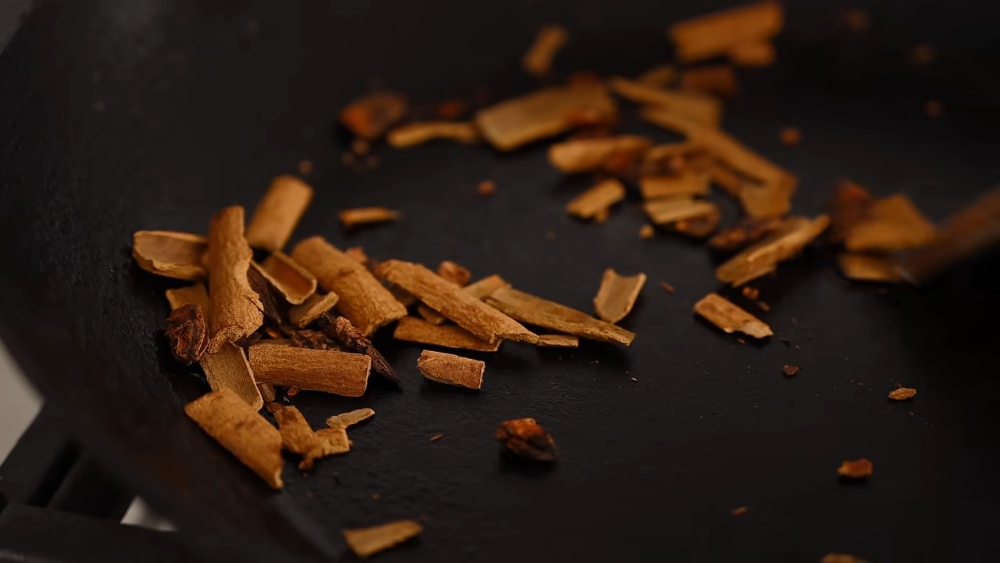
Yeung places 1 cup of loose black tea leaves in a large, heatproof bowl. He then turns to the spices, adding two cinnamon sticks and three pieces of star anise to a mortar. The spices are coarsely crushed with a pestle rather than ground into a fine powder.
This helps open them up before toasting. Yeung places the crushed cinnamon and star anise in a dry frying pan over medium heat, stirring them for a few minutes.
The brief toast serves a specific purpose: It activates the spices’ natural oils and gives their aroma a head start. Once fragrant, you can turn off the heat and add the toasted spices to the bowl of black tea leaves.
Steeping and storing the Thai tea base
A generous pinch of salt follows, along with approximately one-half teaspoon of vanilla extract and one-quarter cup of cane sugar. The salt is a small but useful addition in such a sweet drink, helping sharpen and balance the other flavors rather than making the tea taste salty.
Yeung then brings approximately 4 cups of water to a boil. He pours the hot water over the tea, spices, vanilla, sugar, and salt, giving everything a thorough stir.
The tea steeps for only three to five minutes. That relatively short brewing time allows the black tea to develop its bold character without sitting indefinitely and becoming unnecessarily harsh.
Once steeped, the liquid is poured through a sieve into a second bowl. The sieve catches the tea leaves, cinnamon, and star anise, leaving behind a smooth, deeply flavored tea concentrate.
The resulting base makes around four drinks. Like the condensed milk, it can be prepared in greater quantities when a larger supply is needed.
It can also be used immediately. For make-ahead drinks, Yeung allows the tea to cool before refrigerating it and says the base should keep for up to a couple of weeks.
Read more: How To Make This Tofu Pad Thai
Turning the components into an iced drink
Once both elements are ready, assembling the drink takes little more than a minute.
Yeung combines 2 tablespoons of coconut condensed milk with 1 cup of the prepared Thai tea base. He stirs them thoroughly, transforming the dark tea into a vivid orange-caramel color.
Then, Yeung pours the sweetened tea into a cup filled with ice. Traditional Thai iced tea is often finished with evaporated milk, but Yeung replaces it with a small amount of creamy oat milk.
As the oat milk meets the tea, it creates the marbled appearance associated with the drink: Pale, creamy ribbons move through the orange tea before the layers are stirred together.
The result is an especially rich vegan Thai tea, with bold tannins from the black tea, coconut-derived sweetness, gentle spice and two different sources of plant-based creaminess.
“This should literally be a dessert,” Yeung says after tasting the finished drink. “It is so rich and creamy and decadent.”
He describes the coconut condensed milk as bringing a subtle fruitiness and an almost honey-like sweetness. The cinnamon and star anise remain present without overpowering the tea. They provide what he calls a “playful hint” of spice.
The tea’s distinctive orange color is more muted and natural than the brilliant hue created by some commercial mixes. However, it still develops a warm caramel appearance when blended with the coconut condensed milk.
Most importantly, the drink rewards advance preparation. Making the tea base and condensed milk requires some simmering, steeping, straining, and cooling, but neither component needs to be prepared every time a craving arrives.
Stored separately in the refrigerator, they can be combined with ice and oat milk whenever needed. As Yeung puts it, “With a little bit of prep ahead of time, you can have Thai iced tea for days.”
Please note: PBN runs a sponsored content model. To explore how you can get featured, please email [email protected] or visit everkinddigital.com.