Community
 Print
Print



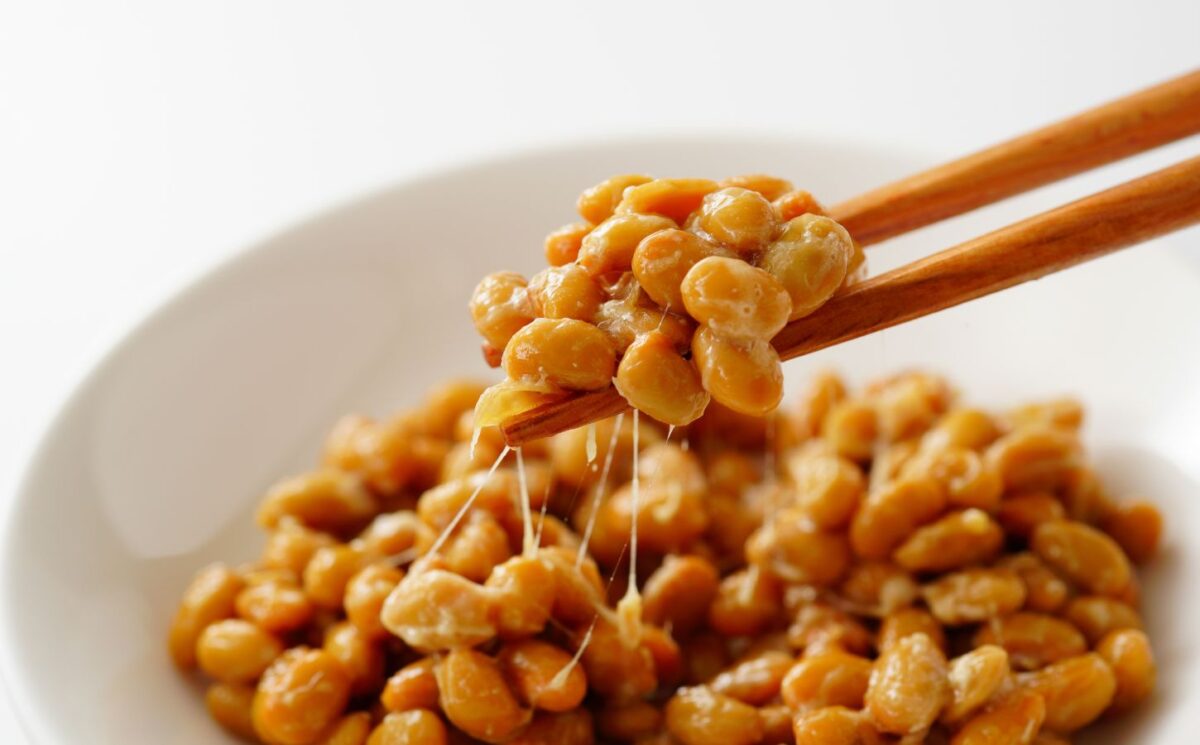
Nattokinase and artery plaque have become a frequent pairing on social media, where supplement ads can make the enzyme sound like a shortcut to cleaner arteries. Mic the Vegan has seen those claims too, and in a recent video he sets out to find out whether there is actually good evidence behind them.
Mic the Vegan is a science-focused YouTuber with a master’s degree in public health who regularly examines nutrition and health research through a vegan lens. This time, he looks at studies on nattokinase in both supplement form and traditional natto, asking whether people should be “slamming down this natto supplement” or treating the trend with more caution.
Read more: DIY Natto: A Home Fermentation Guide to Japan’s Healthiest Breakfast
What are natto and nattokinase?
Find more videos about vegan health, science, and nutrition on Mic the Vegan’s YouTube channel.
Natto is a traditional Japanese food made by fermenting whole soybeans with Bacillus bacteria. Traditionally, Mic explains, the beans were aerobically fermented in rice straw bundles, producing natto’s famously sticky texture and roughly 1,000 to 2,000 units of nattokinase per serving. Commercial supplements are made differently, using aerated vats before the nattokinase is extracted and refined. Some supplement doses reach 10,000 units, and the refining process also removes vitamin K2.
Soybeans work particularly well because they provide the protein-rich environment the bacteria need. Mic says soybeans are “just great for this because this is a protein enzyme and soybeans have a large amount of protein in them.” Nattokinase itself is a protease, meaning it breaks proteins apart, but Mic is especially interested in the fact that the enzyme is also a large protein that appears capable of surviving digestion.
He notes that nattokinase is 275 amino acids long, yet it appears to resist the stomach’s acidic pH and make it through the intestinal wall into the bloodstream. That is unusual because the body normally absorbs individual amino acids and much shorter peptide chains. Mic says the enzyme appears to use cellular transport involving endocytosis, joking that “it’s got some magic key.” He also stresses that its presence in the blood does not appear to be accidental, saying, “It’s not from some leaky gut phenomenon where it’s getting in when it shouldn’t.”
Natto consumption is linked to better heart health

Mic also looks at population studies from Japan, which offer some intriguing clues about natto and cardiovascular health. One 2017 study involving around 30,000 people found that natto was associated with a statistically significant 25% lower risk of death from cardiovascular disease. In the same research, total soy protein intake was linked to a 25% lower risk of death from stroke, while natto was associated with a 32% lower risk.
A separate study of roughly 90,000 middle-aged adults found a 24% lower risk of cardiovascular disease-related death among the highest natto consumers. Tofu also performed well, with the highest consumers showing a 26% lower risk of heart disease mortality. Mic sums up the broader pattern simply: “Soy is clearly just good for you.” These studies are observational, however, so they cannot prove that natto itself caused the lower risks, and people who eat more soy may differ in other diet and lifestyle habits too.
Vitamin K2 may be another piece of the picture. Natto is especially rich in the MK-7 form of K2, and Mic points to a randomized controlled trial in which K2 appeared to slow the progression of coronary artery calcification by about 40%, although it did not reverse it. Most concentrated nattokinase supplements remove K2, making them quite different from the whole fermented food. “I can’t help but wonder if the K2 and the nattokinase are working together,” Mic says.
Can nattokinase actually shrink plaque?
The most attention-grabbing evidence comes from a human study involving around 1,000 people who took nattokinase for 12 months. Participants taking 10,000 units reportedly experienced a 36% reduction in carotid artery plaque, measured using Doppler ultrasound. Mic says “the results are quite shocking,” but he quickly points out that the study was not randomized or placebo-controlled.
There is also a significant conflict of interest. Mic notes that most of the authors were paid by a company producing nattokinase supplements, reacting with two words: “Huge conflict.” That does not automatically make the findings invalid, but it does make independent replication particularly important.
Another randomized controlled trial followed participants for three years and found no significant benefit. However, that study used only 2,000 units, the same lower dose that failed to show plaque reduction in the larger study. “If it had 10,000, then we’d have a real answer,” Mic says. “We don’t have a real answer. We need more research.”
Animal studies have also repeatedly shown reductions in arterial lesions, but Mic cautions against assuming the same effect will happen in humans. Plaque can be easier to reverse in rodents because of differences in metabolism, plaque size and age, as well as the extreme diets and genetic modifications sometimes used in experiments.
How might the enzyme work?
Part of the interest in nattokinase comes from what it appears to do to fibrin, a fibrous protein involved in blood clot formation. Mic compares the enzyme to “a little pair of scissors,” because it can break down fibrin without appearing to cut apart collagen or elastin in healthy vascular tissue.
Nattokinase may also support plasmin, one of the body’s own fibrin-dissolving enzymes. Mic describes the combined effect as a “one-two punch”: Nattokinase can act on fibrin directly while also boosting the body’s own fibrin-clearing processes. As he explains, “it’s cutting the fibrin directly and then it is helping increase plasmin, which is cutting the fibrin also.”
That does not necessarily mean it can directly dismantle established arterial plaque. Fibrin in newer clots is exposed to circulating blood, while fibrin inside a long-term plaque may sit beneath a collagen-rich cap, making it harder for nattokinase in the bloodstream to reach. Any effect on older lesions may therefore rely more on the body’s own plasmin system.
Calcified plaque presents another challenge. Mic says those plaques are “almost more akin to bone,” and notes that while they may be less likely to rupture, they can still restrict blood flow over time. This is why the most plausible potential benefit may relate more to softer plaques and clot-related processes than to heavily calcified arteries.
Read more: Soy And Legumes Could Lower Hypertension Risk, Finds Study
Promising, but not proven
The same effects that make nattokinase interesting also mean supplements should be approached carefully. Mic highlights research showing that even a single oral dose can affect clotting and coagulation factors, and nattokinase also appears to have an anti-platelet effect. “Of course, you want to talk to your doctor before taking this,” he says, particularly for people using medications that affect blood viscosity or clotting.
Mic also mentions warnings against taking nattokinase in the two weeks before surgery because of a possible increased risk of bleeding. At the same time, he says the available human evidence suggests it is “quite safe and well tolerated,” while stressing that there are still not enough studies to know whether it is worth taking for healthy people.
His overall conclusion is deliberately cautious. “This is promising but not proven,” Mic says. Animal research does not always translate to humans, the most dramatic human findings come from an industry-linked study, and the randomized trial used a lower dose.
For now, claims about nattokinase and artery plaque remain ahead of what the evidence can firmly establish. Mic remains hopeful, noting that “it’s possible that a high dose of this stuff in a year can chop off 35% over a third of your arterial plaque or that it doesn’t.” Until larger, independent high-dose trials are carried out, nattokinase remains an intriguing possibility rather than a proven way to shrink arterial plaque.
Please note: PBN runs a sponsored content model. To explore how you can get featured, please email [email protected] or visit everkinddigital.com.