Community
 Print
Print



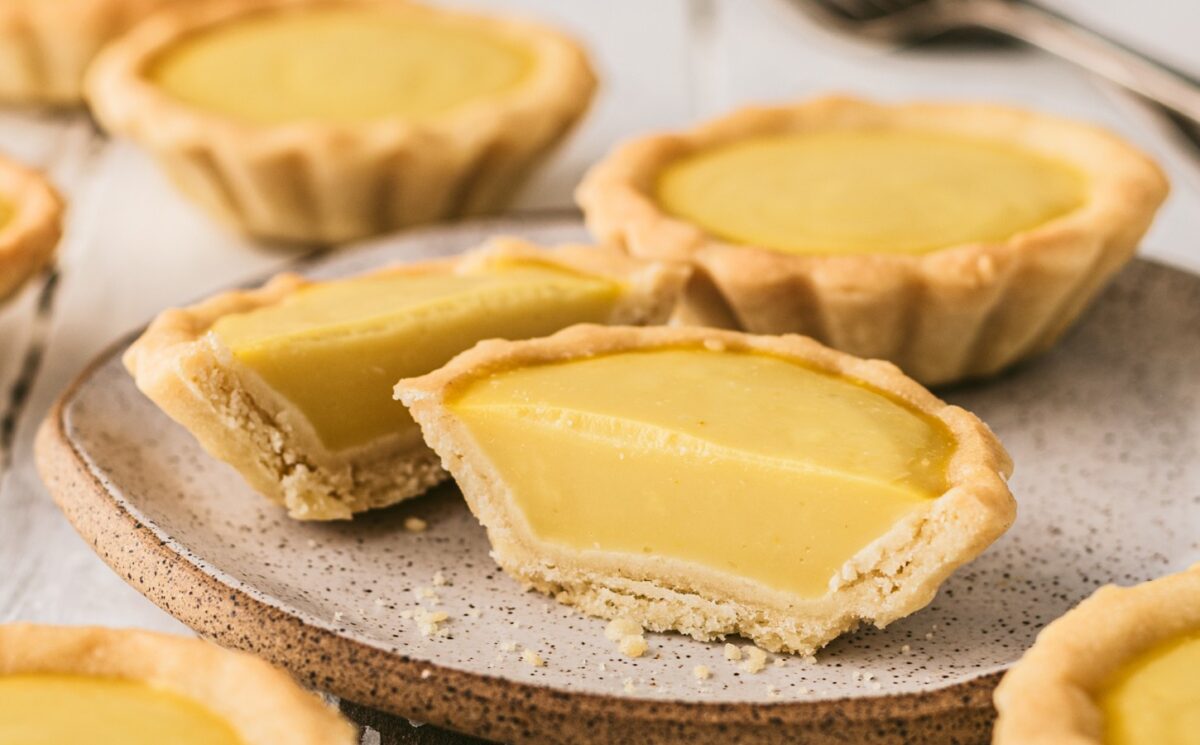
These vegan Chinese egg tarts recreate the soft custard filling and flaky pastry people expect from a classic bakery version. The filling is smooth, lightly sweet, and creamy, while the crust stays crisp and buttery around the edges. Kala namak, also known as black salt, helps give the tarts their familiar eggy flavor without using eggs.
Helen Au shares the recipe in her cookbook Cozy Vegan Pies and Tarts. The custard uses oat milk, vegan evaporated milk, and coconut custard powder to create the texture found in traditional Chinese egg tarts. Agar-agar helps the filling set once chilled, while a little turmeric gives the custard its warm yellow color. The result feels very close to the kind of tart you would pick up from a Chinese bakery.
Read more: This Crème Brûlée is 100% Vegan
These vegan Chinese egg tarts work well as a dessert, afternoon snack, or something to serve with tea or coffee. Since the recipe makes twelve tartlets, they are also useful for gatherings or sharing with friends and family.
History of egg tarts
Egg tarts exist in many forms around the world. Portugal has pastel de nata, Britain has custard tarts, and Hong Kong and mainland China have their own bakery-style versions with silky custard fillings and flaky pastry shells. Chinese egg tarts became popular through Cantonese bakeries and dim sum restaurants. Vegan versions like this one now make it possible to recreate those familiar flavors and textures without dairy or eggs.
Reprinted with permission from Cozy Vegan Pies and Tarts by Helen Au. Page Street Publishing Co. 2022. Photo credit: Helen Au.
Prepare the vegan Chinese egg tarts
Ingredients
For the Crust
- Vegan butter for greasing pans
- All-purpose flour for dusting
- 1 vegan pie crust unbaked
For the Glaze
- 10 ml (½ tbsp) maple syrup
- 28 g (2 tbsp) unsalted vegan butter melted
For the Filling
- 500 ml (2 cups) unsweetened oat milk (or soy milk)
- 250 ml (1 cup) vegan evaporated milk
- 40 g (3 tbsp) vegan coconut custard powder
- 150 g (¾ cup) cane sugar
- ⅛ tsp kala namak salt see Note
- Dash of turmeric powder optional
- ¾ tsp agar-agar powder + 8 ml (½tbsp) cold water combined
Instructions
- Preheat the oven to 350°F (180°C). Grease twelve (21⁄2-inch [6-cm]) tartlet pans with vegan butter or coconut oil. Lightly flour a sheet of parchment paper.
- Make the vegan pie crust but don’t bake it. Take the dough out of the refrigerator and divide it into twelve pieces. Place one of the pieces of dough on the center of the parchment paper. Lightly flour it and cover with a second sheet of parchment paper. Roll the dough into a round shape that’s 4 inches (10 cm) in diameter. Carefully transfer the dough into one of the buttered pans. There should be some dough hanging over. Trim off the excess dough to a 1⁄4-inch (6-mm) overhang. Fold the overhang dough under itself and pinch the crust to make a decorative edge crust. Repeat this step with the remaining dough. Transfer the pans to the freezer for 5 minutes.
- To make the glaze, add the maple syrup and vegan butter to a small bowl and mix well. Brush the crusts with the glaze. Add a sheet of parchment paper to the middle of the pie crusts and add pie weights or dried beans. Bake for 13 to 15 minutes, or until lightly golden. Remove the crusts from the oven and let them cool completely before adding the filling.
- To make the filling, add the oat milk, vegan evaporated milk, custard powder, cane sugar, kala namak salt and turmeric powder (if using) to a saucepan over medium heat. Whisk until all the ingredients are well combined and there are no lumps visible. Add the agar-agar slurry and stir for 1 minute, or until it starts to thicken slightly. Pour the filling into the crusts. Let them cool for 10 minutes before transferring them to the refrigerator to set for 2 hours or overnight.
PBN runs a sponsored content model. To explore how you can get featured, please email [email protected] or visit everkinddigital.com