Community
 Print
Print



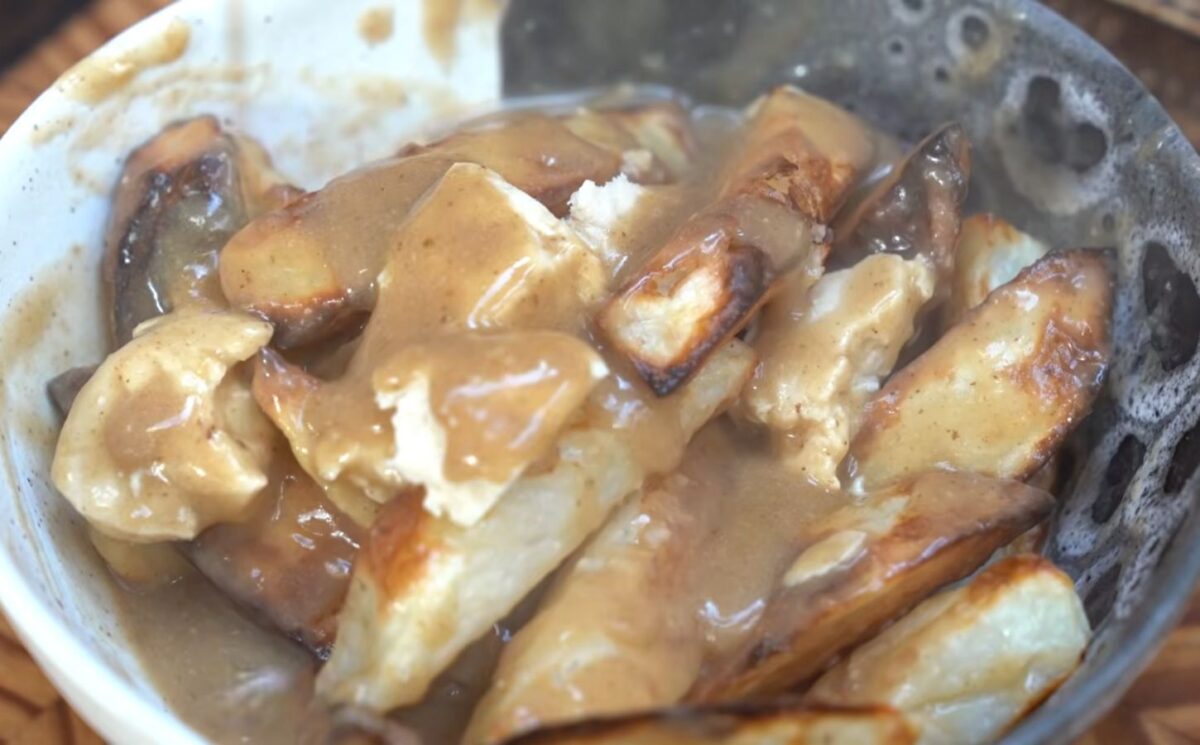
Miyoko Schinner has built a career around answering one big question: how far can plant-based cheese really go? The vegan cheese pioneer, entrepreneur, and cookbook author has spent decades pushing vegan food into new territory. Now, she’s tackling a Canadian comfort food favorite with a vegan poutine recipe that swaps dairy cheese curds for something unexpected: fermented tofu.
Schinner, known for her YouTube channel The Vegan Good Life with Miyoko, recently shared a video showing viewers how to make vegan poutine with high-protein tofu cheese curds that stretch, bounce, and even squeak. The project is especially personal because Schinner admits she never tried traditional poutine before going vegan.
Read more: How To Make Miyoko’s Famous Vegan Roadhouse Cheddar At Home
“You know, I went vegan when I was in my twenties and I hadn’t gone to Canada at the time, so I’d never had cheese curds,” Schinner says. “And I’ve never had poutine.”
The classic Canadian dish combines fries, cheese curds, and gravy. But Schinner wanted to do more than simply recreate it. She wanted to understand why dairy cheese curds behave the way they do and whether tofu could deliver something similar.
‘Why isn’t tofu cheese?’
For more of Miyoko Schinner’s vegan cheese recipes, check out her YouTube channel.
Schinner explains that tofu and cheese have more in common than people often realize.
“What do I have here?” Schinner says. “Okay, I have been wondering all my life, why isn’t tofu cheese?”
Both foods begin with coagulated proteins. Cheese comes from coagulated dairy milk. Tofu comes from coagulated soy milk. In both cases, curds form before eventually becoming the finished product.
The biggest difference comes afterward.
“With dairy cheese, not only do you coagulate the proteins, you ferment it with a bacterial culture,” Schinner says.
That fermentation process lowers acidity and changes protein and fat structures over time, helping create cheese’s flavor and texture. Standard tofu production skips fermentation entirely.
“But why not?” Schinner asks.
Instead of making conventional tofu, Schinner decided to borrow techniques from cheesemaking. Her goal was to ferment soy curds before pressing them, bringing tofu production one step closer to dairy cheese.
Creating high-protein tofu cheese curds
The vegan poutine recipe begins with soy milk. Schinner makes her own because it creates especially rich results, though she says carefully chosen store-bought versions work too.
“You can get a soy milk that doesn’t have any additives in it,” Schinner says. “Try to get one that just has soybeans water.”
She heats the soy milk to above 165 degrees Fahrenheit before adding dissolved calcium sulfate, also called food-grade gypsum. The ingredient acts as a coagulant, helping separate soy milk into curds.
Almost immediately, the transformation begins.
“See the curds already forming?” Schinner says.
Once coagulated, the mixture takes a different path than ordinary tofu. Schinner transfers the curds into a sterilized bowl and introduces fermentation culture.
“So, we are going to actually ferment this,” Schinner says.
She uses a probiotic fermentation blend but notes that probiotic capsules or yogurt could potentially help achieve a similar effect. The main objective is lowering acidity.
The curds then sit in a warm place for roughly 16 to 24 hours.
When Schinner checks the mixture the next day, she confirms it has developed noticeable tanginess.
“I tested the pH,” she says. “It’s around 4.3.”
The fermentation step moves the soy curds closer toward cheese territory.
“That’s the difference between tofu and cheese,” Schinner says. “They’re both made in a very similar process of making curds, but cheese is fermented.”
How Schinner creates squeaky vegan cheese
After fermentation, Schinner moves on to the step that transforms the tangy soy curds into something closer to cheese. Rather than pressing them firmly into tofu blocks, she drains off excess moisture while keeping the curds soft. Traditional cheese curds stay tender and springy, so she avoids compacting them too much.
The soft fermented curds go into a blender while the leftover whey-like liquid gets a second purpose. Schinner measures out half a cup and adds agar, a seaweed-derived gelling ingredient often used in vegan cooking. She heats it on the stove until fully activated before blending it into the curds.
Timing becomes important at this point. Agar begins setting quickly as it cools, so Schinner works fast. Salt goes into the mixture alongside psyllium husk powder, which helps create structure while adding something dairy cheese lacks entirely: fiber.
“This is a cheese that has the protein of tofu, but it has something that regular cheese doesn’t have,” Schinner says. “Which is fiber.”
As the blender runs, the mixture thickens dramatically. What starts as loose fermented curds turns into something dense, sticky, and noticeably more cheese-like. Schinner transfers it into a container and leaves it to chill for several hours.
Once fully set, the results surprise even her. The cheese pulls apart in strands similar to string cheese. It slices cleanly. Most importantly for this vegan poutine recipe, it develops some of the distinctive texture cheese curds are known for.
“It is a little squeaky,” she says.
She explains that the curds could become even more cheese-like with extra time in a salty brine made from leftover whey. The liquid would help deepen flavor while increasing saltiness. But for poutine, Schinner decides the cheese is ready.
Crispy fries make the foundation
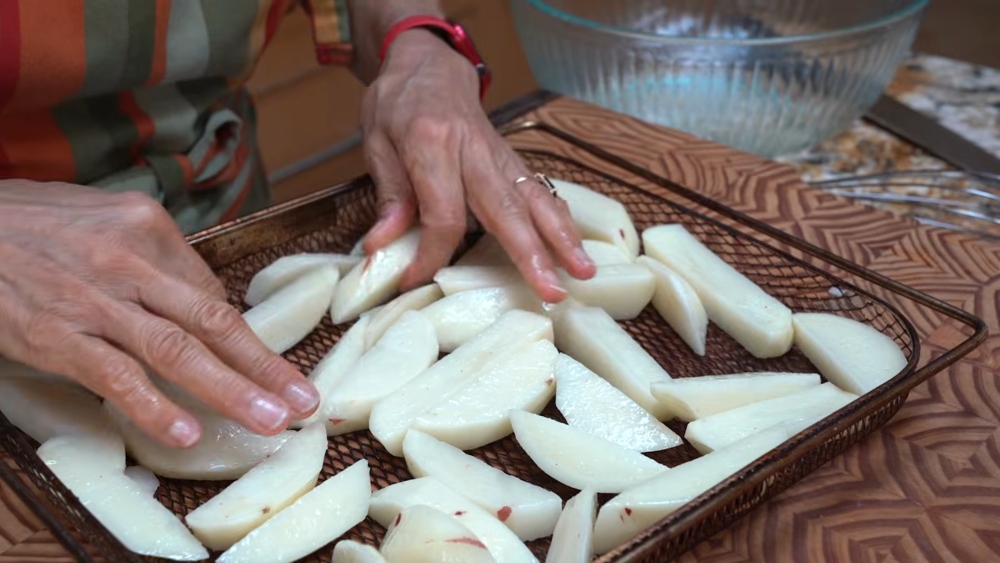
Good poutine starts long before gravy enters the picture. Fries need enough texture to stand up to toppings without turning soft immediately. Schinner focuses heavily on preparation to make sure the potatoes stay crisp.
She cuts thick fries and immediately places them into cold water. The soaking stage matters whether the potatoes are air fried or deep fried.
“When you’re making fries, whether you’re deep frying or air frying, soak them for at least 1 hour,” Schinner says.
Her preference is soaking them overnight. The water pulls starch away from the potatoes, helping them crisp more effectively during cooking.
“It draws out a lot of that starch,” Schinner says, “and you get a fluffier, crispier fried potato that way.”
After drying the potatoes thoroughly, she coats them lightly with avocado oil and salt before moving them into the air fryer. The finished fries come out golden with crisp edges and soft centers, exactly the kind of texture needed to support gravy without collapsing underneath it.
Mushroom gravy adds savory depth
Traditional poutine gravy often combines meat-based stock with a relatively light consistency that coats fries without overwhelming them. Schinner takes inspiration from those flavors while creating something entirely plant-based.
Instead of relying on packaged broth, she builds the gravy around her homemade mushroom bouillon base.
“We’re taking a slight departure from the traditional poutine gravy,” Schinner says. “But I guarantee you it’s going to be delicious.”
The process begins with vegan butter melting in a pan alongside a small amount of oil. Flour goes in next to create a roux, which slowly develops flavor as it cooks.
“We’re going to try to get that to brown just a little bit,” Schinner says.
As the flour darkens, nutty aromas begin building in the pan. Schinner combines hot mushroom stock separately before pouring it gradually into the roux.
“When you’re making gravy, always start with a hot stock,” Schinner says.
The technique prevents lumps and helps the gravy come together quickly. Soy sauce adds another layer of savoriness while a splash of red wine rounds out the flavor.
Unlike thicker American gravies, Schinner wants something lighter so that it coats the fries and cheese evenly.
As the gravy finishes cooking, she tastes it directly from the spoon. “I could just drink that like soup,” she says.
Read more: This Fermented Vegan Mozzarella Melts Like The Real Thing
Miyoko Schinner tries (vegan) poutine for the first time
With every component finished, Schinner finally builds the dish she has spent years hearing Canadians talk about.
Hot fries go first. The homemade cheese curds get torn into smaller pieces and scattered across the potatoes. Then comes the gravy.
One detail matters more than complete meltability. Cheese curds in traditional poutine soften from heat without disappearing entirely. Schinner watches carefully to see how her tofu version behaves.
“The cheese curds are holding up,” she says.
The hot gravy softens them while preserving their structure. More importantly, they keep some of the springy texture she worked to create.
“They’re still a little squeaky.”
For someone trying poutine for the first time after decades of vegan cooking, the moment feels surprisingly meaningful. Schinner jokes about Canadian food traditions while taking another bite, clearly relieved that the experiment worked.
“I think that’s a winner,” she says. “I would serve this. I would eat this. This is good.”
The finished vegan poutine recipe reflects something Schinner has spent much of her career proving: plant-based cooking works best when it does more than imitate familiar foods. Sometimes understanding how ingredients behave opens entirely new possibilities.
Please note: PBN runs a sponsored content model. To explore how you can get featured, please email [email protected] or visit everkinddigital.com.